
A Guide to Replacing Missing Teeth
Losing a tooth changes more than your smile. It can affect how you chew, how clearly you speak, and how confident you feel in everyday moments like laughing, eating out, or taking photos. This guide to replacing missing teeth is designed to help you understand your options clearly, so you can make a decision that feels right for your health, comfort, and budget.
Some people lose a tooth because of decay, gum disease, injury, or a failed filling or crown. Others have been missing teeth for years and are finally ready to do something about it. Whatever the reason, the next step is not the same for everyone. The best solution depends on where the tooth is, how many teeth are missing, the condition of your gums and bone, and what matters most to you day to day.
Why replacing missing teeth matters
A gap in your smile may seem manageable at first, especially if it is toward the back of the mouth. Over time, though, missing teeth can lead to changes that are harder to ignore. Nearby teeth can begin to shift into the open space. Opposing teeth may grow outward because they no longer meet resistance when you bite. That can affect your bite, put uneven pressure on healthy teeth, and make cleaning more difficult.
There is also the question of bone support. Natural tooth roots help stimulate the jawbone. When a tooth is missing, that area can gradually lose bone volume. This matters for appearance, chewing strength, and future treatment choices. Replacing a missing tooth is often about preserving what is still healthy, not just filling a space.
Your guide to replacing missing teeth: the main options
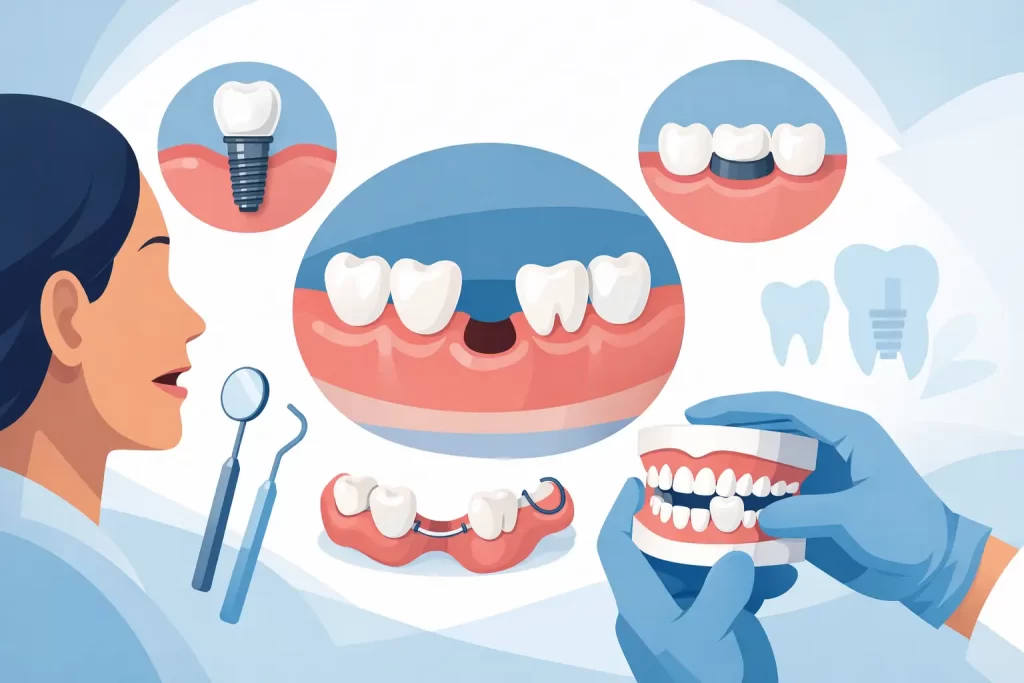
Most patients are deciding between dental implants, bridges, and dentures. Each has clear advantages, and each comes with trade-offs.
Dental implants
A dental implant replaces the root of a missing tooth with a small titanium post placed in the jawbone. Once it heals, a crown is attached on top to create a natural-looking replacement tooth.
For many patients, implants feel the most like natural teeth. They do not rely on neighboring teeth for support, and they can help preserve jawbone in the area. They are also popular because they stay fixed in place, which means no slipping during meals or conversation.
That said, implants are not always the fastest or lowest-cost option. Treatment can take several months depending on healing time, and enough bone support is needed for placement. Some patients may need preparatory care before treatment can begin.
Dental bridges
A bridge fills the gap by using the teeth on either side as support. Those supporting teeth are prepared, and a connected restoration is placed to replace the missing tooth in between.
Bridges are a well-established option and can work especially well when the neighboring teeth already need crowns or have large restorations. They are fixed in place, generally quicker than implants, and can restore both appearance and function very effectively.
The trade-off is that a traditional bridge depends on the surrounding teeth. If those teeth are healthy and untouched, some patients prefer not to prepare them. Bridges also do not replace the tooth root, so they do not provide the same bone stimulation as an implant.
Partial and full dentures
Dentures are removable appliances that replace several missing teeth or a full arch of teeth. A partial denture fills spaces when some natural teeth remain. A full denture replaces all teeth in the upper or lower arch.
Dentures are often the most affordable way to replace multiple missing teeth, and they can make a major difference in appearance and chewing ability. Modern dentures can also look more natural and feel more refined than many people expect.
Still, removable appliances take an adjustment period. They may need periodic relining or replacement as the mouth changes over time. Some patients do very well with dentures, while others want more stability and prefer to explore implant-supported solutions if they are suitable candidates.
How to choose the right option
The best treatment is not always the most expensive one or the newest one. It is the one that fits your mouth, your health, and your goals.
If you are missing one tooth and want the closest match to a natural tooth, an implant is often worth discussing first. If you want a fixed solution but the neighboring teeth already need treatment, a bridge may make excellent sense. If several teeth are missing and cost is a major factor, a partial denture may be a practical place to start.
Your timeline matters too. Some patients need a quicker solution because of work, travel, or an upcoming event. Others are willing to take more time for a longer-term option. There is no one-size-fits-all answer, and a careful dental assessment makes a real difference here.
What your dentist will evaluate first
A good treatment plan starts with a close look at the whole picture, not just the gap itself. Your dentist will check the health of your gums, the condition of nearby teeth, your bite, and the amount of available bone. Digital x-rays and intraoral imaging can help show details that are not visible during a simple visual exam.
This matters because replacing a missing tooth successfully is about support and stability. If gum disease is active, it may need to be treated first. If a neighboring tooth has decay or a crack, that can influence whether a bridge or another option makes more sense. If you have been missing a tooth for a long time, bone loss may affect implant planning.
A thoughtful consultation should leave you with clear options, not pressure. You should understand what each treatment can do, what it cannot do, and what kind of maintenance it requires.
Cost, comfort, and long-term value
Patients often ask which option is best for their budget. That is a fair question, but it helps to think beyond the upfront fee.
Dentures and partial dentures usually have the lowest initial cost. Bridges often fall in the middle. Implants usually involve the highest initial investment. But cost over time can look different depending on maintenance, repairs, replacement cycles, and how long the restoration is expected to serve you well.
Comfort also has a long-term value. A restoration that feels secure, looks natural, and lets you eat with confidence can improve daily life in ways that are hard to measure on paper. For some people, removable treatment is perfectly acceptable. For others, the convenience of a fixed option matters a great deal.
Replacing front teeth vs. back teeth
Not every missing tooth creates the same challenge. Front teeth are often more urgent because of appearance and speech. In these cases, patients usually want a solution that blends naturally with the shape and shade of surrounding teeth.
Back teeth matter just as much for chewing and keeping the bite balanced. Because they take more force, durability becomes especially important. Some patients delay replacing a back tooth because it is less visible, but that can lead to bite changes and extra strain on other teeth over time.
What to expect during treatment
The process depends on the option you choose. A bridge typically involves preparing the supporting teeth, taking impressions or digital scans, and placing the final restoration once it is ready. A denture involves measurements, fittings, and adjustments to improve comfort and function.
Implant treatment usually takes longer because healing is part of the process. After the implant is placed, the bone needs time to bond with it before the final crown is attached. In some cases, temporary solutions can help maintain appearance while treatment is underway.
Whatever path you choose, follow-up matters. Small adjustments can make a big difference in comfort, speech, and bite.
Caring for your replacement teeth
Replacing a missing tooth does not mean you can stop thinking about oral health. Crowns, bridges, implants, and dentures all need proper care.
Fixed restorations still require daily brushing and cleaning around the gumline. Bridges need special attention under the replacement tooth. Dentures should be cleaned thoroughly and checked regularly for fit. Implant restorations also need healthy gums and good home care to stay successful.
This is one reason patients appreciate ongoing care in a practice that focuses on both restoration and prevention. At Restorative Dental Jamaica, treatment planning is centered on preserving healthy teeth, restoring comfort, and helping patients feel informed at every step.
When to act
If you have a missing tooth, waiting may feel easier than deciding. But time can narrow your options. Teeth may shift, bone can change, and the simple fix you could have had earlier may become more complex later.
You do not need to have all the answers before booking an evaluation. You just need a starting point. A calm, personalized consultation can help you understand what is possible now and what will serve you best in the years ahead.
The right replacement should let you eat comfortably, smile freely, and feel confident that your oral health is being protected, not patched over. That is a decision worth making with care.
Leave a reply







Leave a reply