
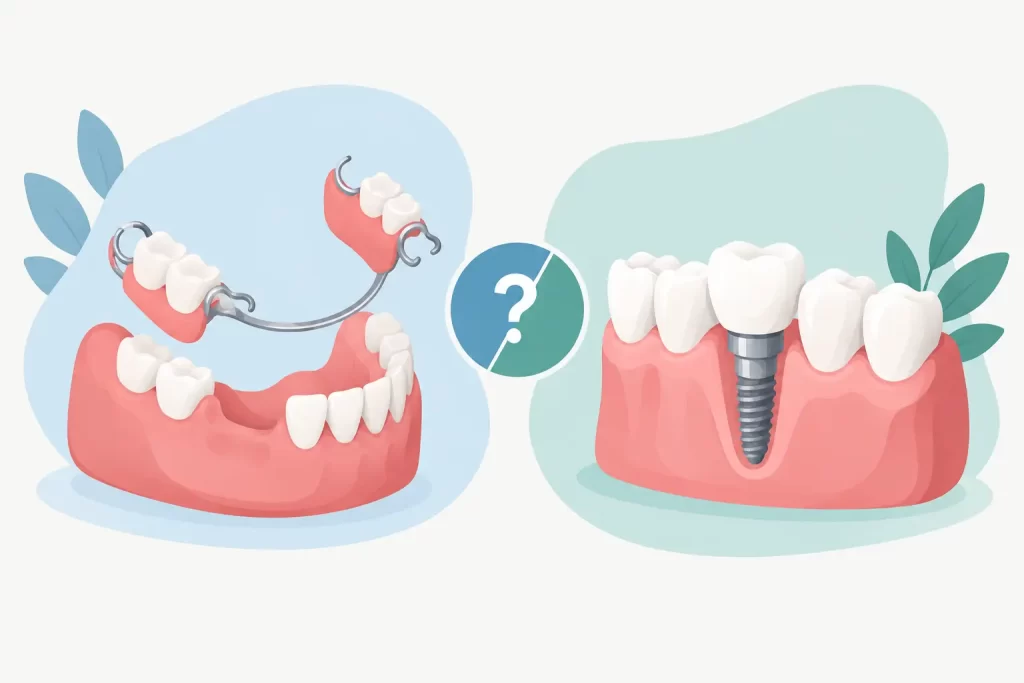
Partial Dentures Versus Implants: Which Fits?
A missing tooth can change more than the way a smile looks. It may make chewing less comfortable, affect speech, allow nearby teeth to shift, and leave you feeling self-conscious in social or professional settings. When comparing partial dentures versus implants, the right choice is rarely about choosing the most expensive option. It is about finding a treatment that supports your oral health, comfort, lifestyle, and long-term goals.
Both options can restore the appearance and function of your smile. The differences lie in how they are supported, how they feel day to day, the treatment process, and the care they require. A personalized dental assessment is the best way to understand which solution is appropriate for your mouth.
Understanding Partial Dentures
A partial denture is a removable appliance designed to replace one or several missing teeth when natural teeth remain in the mouth. The replacement teeth are attached to a gum-colored base, often with clasps or precision attachments that help hold the appliance in place around neighboring teeth.
For many patients, partial dentures offer a practical path to restoring gaps in the smile without surgery. They can improve chewing ability, support clearer speech, and help prevent the surrounding teeth from drifting into open spaces. Modern partial dentures can also be made to look natural, with materials selected to blend comfortably with the rest of the smile.
One of the main advantages is that treatment is usually completed more quickly than implant treatment. Partial dentures are also generally less expensive upfront, which can make them a sensible option for patients replacing several teeth or working within a defined budget.
That said, a partial denture must be removed for cleaning and should not be worn while sleeping unless your dentist has given specific instructions. It may take time to adjust to the feel of an appliance in the mouth, especially during eating and speaking. Over time, changes in the gums and jawbone can affect the fit, so adjustments, relines, or replacement may be needed.
How Dental Implants Replace Missing Teeth
A dental implant replaces the root portion of a missing tooth. A small titanium implant post is placed in the jawbone, where it gradually bonds with the bone. Once healing is complete, the implant can support a custom crown for a single missing tooth or help secure a bridge or denture when several teeth are missing.
Because an implant is anchored in the jaw, it is fixed in place. Many patients appreciate that it feels closer to a natural tooth than a removable appliance. You do not remove an implant-supported crown at night, and you can brush and floss around it as part of your usual home-care routine.
Implants can also help preserve jawbone. After a tooth is lost, the bone in that area may gradually shrink because it is no longer receiving the stimulation created by chewing. An implant transfers chewing forces to the bone, helping maintain the structure of the jaw in that location.
However, implants are not an instant treatment. They involve a surgical procedure and a healing period, and the full process can take several months. Good overall health, healthy gums, adequate bone, and consistent oral hygiene all matter. Some patients may need additional treatment, such as bone grafting, before implant placement is possible.
Partial Dentures Versus Implants: Key Differences
The most noticeable difference between partial dentures and implants is stability. A partial denture rests on the gums and is supported in part by remaining teeth. Even when it fits well, it can have slight movement during meals or conversation. Dental adhesives may help some patients, but they do not replace the importance of a properly fitted appliance.
An implant is secured in the jawbone, so it does not move in the same way. This can make eating feel more natural and may allow for a wider range of foods. Still, comfort depends on thoughtful planning, quality materials, and regular dental care. An implant is a durable restoration, not a reason to neglect cleanings or home hygiene.
Cost is another meaningful consideration. Partial dentures typically have a lower initial cost because they do not require surgery or an implant post. Implants usually require a greater upfront investment, especially if more than one tooth is being replaced or preparatory procedures are needed. Yet an implant may provide value over time because it is fixed, long-lasting, and designed to support bone health.
The best financial decision is not always the lowest initial fee. Consider how long you expect the restoration to serve you, the likelihood of future maintenance, and how important fixed teeth are to your confidence and daily routine. Your dental team can explain available treatment phases and payment options clearly, so you can make a decision without pressure.
When a Partial Denture May Be the Better Choice
A partial denture may be a good fit when several teeth are missing across different areas of the mouth and a patient wants a removable, budget-conscious solution. It can also be appropriate when there is not enough healthy bone for implants and a patient does not wish to pursue grafting or surgery.
Some patients need a tooth replacement relatively soon after an extraction and may choose a partial denture while healing or while considering a longer-term plan. Others simply prefer a non-surgical approach. There is no one-size-fits-all answer, and a removable option can still provide an attractive, functional result when it is carefully designed and maintained.
Partial dentures do rely on the health of remaining teeth. If the supporting teeth have decay, gum disease, or weak restorations, those concerns should be addressed first. Protecting the natural teeth you still have is always a central part of good restorative care.
When Implants May Be Worth Considering
Implants are often an excellent option for patients missing one tooth or a small number of teeth who want a fixed restoration. They can be especially appealing when neighboring teeth are healthy, since an implant crown does not require reshaping those teeth as a traditional bridge often does.
Patients who dislike the idea of removing a denture each evening may also prefer the fixed feel of an implant. If maintaining jawbone structure is a priority, implants offer an advantage that removable dentures cannot provide on their own.
Even so, implant treatment should begin with a careful examination. Digital X-rays and other imaging help your dentist evaluate bone levels, tooth roots, gum health, bite alignment, and the location of important structures in the jaw. A beautiful result starts with planning that protects both comfort and long-term function.
Your Daily Care Matters With Either Option
A partial denture needs daily cleaning outside the mouth with a soft denture brush and a cleaner recommended by your dentist. It should be handled carefully, stored safely when removed, and brought to regular dental visits so the fit can be checked. Cleaning the remaining natural teeth and gums is equally important, since plaque can collect around clasps and supporting teeth.
Implant crowns require brushing twice daily, cleaning between teeth, and professional cleanings. Although an implant cannot get a cavity, the gums and bone around it can still develop inflammation or infection if plaque is allowed to build up. Regular checkups help your dentist identify early changes before they become more difficult to treat.
Smoking, untreated gum disease, teeth grinding, and poorly controlled medical conditions can affect the success of any restorative treatment. Honest conversations about your health and habits help your dentist recommend an option that is both realistic and protective of your smile.
Choose the Option That Feels Right for Your Smile
At Restorative Dental Jamaica, treatment recommendations begin with listening. Your dentist will consider the number and location of missing teeth, the condition of your gums and remaining teeth, your bite, your expectations, and the level of care that feels manageable for you.
You do not need to decide between partial dentures and implants based on advertisements or someone else’s experience. A well-planned consultation can replace uncertainty with clear answers and a treatment plan designed around your comfort. The best next step is the one that helps you smile, eat, and speak with greater confidence while caring well for the natural teeth that remain.
Leave a reply







Leave a reply