
How to Choose Dental Crowns That Fit Your Smile
A crown should not feel like a compromise. It should let you chew comfortably, speak naturally, and smile without wondering whether a restored tooth looks different from the rest. Knowing how to choose dental crowns starts with looking beyond the material alone. The right choice depends on the tooth being treated, your bite, your smile goals, and the condition of the tooth underneath.
At Restorative Dental Jamaica, crown recommendations are personalized because a strong, natural-looking result is rarely one-size-fits-all. A careful assessment helps protect as much healthy tooth structure as possible while selecting a restoration designed to serve you well over time.
When a Dental Crown May Be the Right Treatment
Dental crowns are custom caps that cover and protect a damaged or weakened tooth. They are commonly recommended after root canal therapy, when a large filling leaves too little healthy tooth structure, or when a tooth is cracked, worn, severely discolored, or broken. A crown can also support a dental bridge or complete a dental implant.
Not every damaged tooth needs a crown. A small cavity may be treated with a white filling, while minor chips or cosmetic concerns may respond well to bonding or veneers. The goal is not to place a crown whenever a tooth has a problem. It is to choose the most conservative treatment that can restore the tooth safely and reliably.
This distinction matters. If too much of the tooth has been weakened, a filling may not have enough solid structure to hold onto. Continuing to patch a heavily restored tooth can raise the risk of a larger break later. In that situation, a crown may help preserve the natural tooth and prevent a more complex treatment.
How to Choose Dental Crowns for Your Needs
The best crown is the one that matches the demands of your mouth. A back molar that handles heavy chewing needs a different balance of strength and appearance than a front tooth that is visible whenever you smile. Your dentist will consider where the tooth sits, how much tooth structure remains, whether you grind your teeth, and how the crown will meet the opposing teeth.
Start with the tooth’s location
Front teeth are highly visible, so shade, translucency, and natural light reflection are especially important. All-ceramic crowns are often an excellent choice in this area because they can be crafted to closely resemble natural enamel.
Back teeth need to withstand greater biting forces. Depending on your bite and the available space, a strong ceramic material or a porcelain-fused-to-metal crown may be recommended. Modern options can look attractive while offering the durability needed for everyday meals.
The right answer is not always the most cosmetic-looking material or the strongest material on paper. A crown must work with your bite. If there is limited room between the upper and lower teeth, your dentist may recommend a material that can be made strong without removing more healthy tooth structure than necessary.
Understand the common crown materials
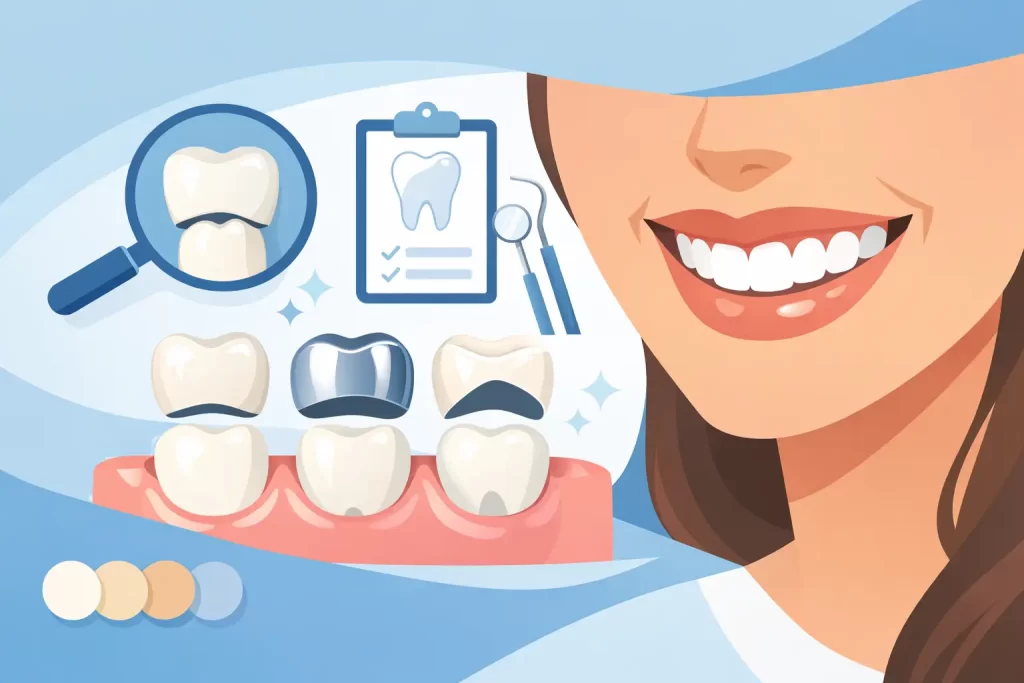
All-ceramic crowns are popular for their natural appearance and metal-free design. They can be a beautiful option for front teeth and many back teeth, especially when color matching is a priority. Different ceramics have different strength levels, so the specific type matters.
Zirconia crowns are known for exceptional durability. They are often considered for molars, patients with heavy bites, and people who clench or grind their teeth. Newer zirconia options can offer a more natural appearance than earlier versions, though highly translucent ceramics may still be preferred for certain front-tooth cases.
Porcelain-fused-to-metal crowns combine a metal foundation with a tooth-colored porcelain exterior. They have a long clinical history and can provide dependable strength. However, the porcelain can sometimes chip, and a dark line may become visible near the gumline if gums recede over time.
Full-metal crowns, such as gold alloys, are very durable and gentle on opposing teeth. Their main trade-off is appearance, which is why they are usually reserved for less visible back teeth. The choice may also be influenced by metal sensitivities, cost, and personal preference.
Your dentist should explain why a particular material suits your tooth rather than simply presenting a menu of options. The material is one decision within a larger treatment plan.
Think about your bite and daily habits
If you wake with jaw soreness, notice worn tooth edges, or have been told that you grind your teeth, mention it before choosing a crown. Grinding can place significant pressure on both natural teeth and restorations. A highly esthetic material may still be suitable, but it may require a protective nightguard and a design that accounts for your bite.
Chewing habits matter too. Regularly biting ice, opening packages with your teeth, or chewing hard candy can damage even a well-made crown. A crown restores function, but it is not indestructible. Choosing a strong material and changing harmful habits protects your investment.
Consider the health of the gum and tooth foundation
A crown can only be as dependable as the tooth and gums supporting it. Before treatment, your dentist should check for decay around old fillings, gum inflammation, cracks below the gumline, and signs of infection. Digital X-rays and close visual examination help reveal concerns that cannot always be seen from the surface.
Sometimes a tooth needs additional treatment before the final crown. This may include a root canal, gum treatment, or a buildup to replace missing tooth structure. If very little healthy tooth remains above the gumline, other options may need to be discussed honestly. A crown should improve the long-term outlook for the tooth, not hide a problem that needs attention.
Appearance Should Be Planned, Not Guessed
A natural-looking crown is about more than selecting a shade called white. Natural teeth have subtle variations in color, brightness, shape, and translucency. For a front tooth, your dentist may evaluate neighboring teeth, your facial features, your smile line, and the amount of tooth visible when you speak.
If you are considering teeth whitening, it is usually wise to discuss it before the final crown shade is chosen. Whitening changes natural tooth color, but it does not lighten porcelain or zirconia. Choosing the crown after whitening can make it easier to match your brighter smile.
Temporary crowns also offer useful information. They protect the prepared tooth while the final crown is being made, but they can also reveal whether the shape and length feel comfortable. Tell your dental team if your bite feels uneven, the tooth feels bulky, or the temporary affects your speech. Small adjustments at this stage can help guide a more comfortable final result.
Ask About the Process and the Long-Term Plan
A quality crown process should feel clear, not rushed. Ask how the tooth will be prepared, whether digital impressions or traditional impressions will be used, how long your temporary crown will be worn, and what to expect at the final fitting. Modern imaging and careful planning support accuracy, comfort, and a crown that blends naturally with your bite.
It is also reasonable to ask about expected longevity, cleaning instructions, payment options, and what happens if the crown chips or loosens. Crowns can last many years, but their lifespan depends on material, fit, oral hygiene, diet, bite forces, and regular dental care.
Daily care is straightforward but essential. Brush twice a day with fluoride toothpaste, clean carefully between teeth, and keep regular dental visits. The crown itself cannot decay, but the natural tooth at its edge can. Healthy gums are equally important, since gum recession can affect both appearance and support.
Choose a Dentist Who Explains the Why
The most reassuring part of choosing a crown is understanding why it is being recommended and why a specific material is right for you. You should feel comfortable asking questions, reviewing options, and expressing concerns about appearance, comfort, timing, or cost.
A well-planned crown is not just a repair for one difficult tooth. It is a chance to protect your natural smile, restore confidence at meals and in photos, and move forward with care that feels considered. If a tooth is damaged, sensitive, or repeatedly breaking, a professional assessment can give you clear answers and a calm path toward a stronger smile.
Leave a reply







Leave a reply