
Best Ways to Replace Teeth Explained
Losing a tooth changes more than your smile. It can affect how you chew, how clearly you speak, and even how confident you feel in everyday moments. If you are weighing the best ways to replace teeth, the right choice depends on your oral health, your goals, your budget, and how much long-term maintenance you are comfortable with.
Some patients want the most natural feel possible. Others want a faster or more affordable option. Many people need help understanding what each treatment actually does and what daily life looks like after treatment. That is where a thoughtful dental evaluation makes all the difference.
The best ways to replace teeth depend on your situation
There is no single treatment that is best for everyone. Age, bone support, gum health, the number of missing teeth, and the condition of nearby teeth all matter. A person missing one front tooth may need a very different solution from someone who has lost several back teeth over time.
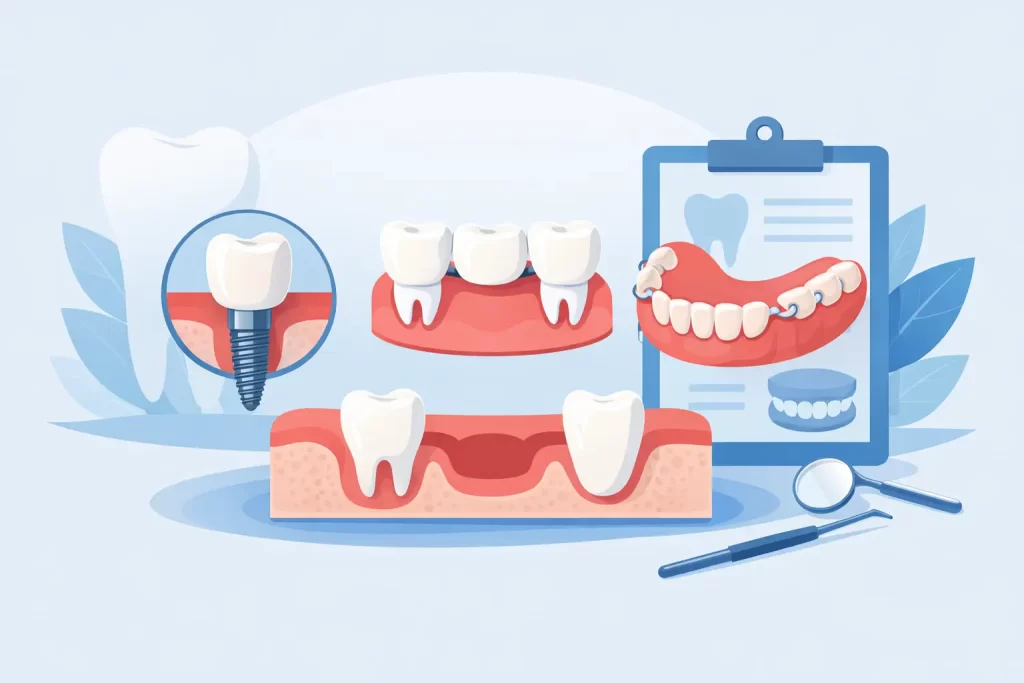
In most cases, the main options are dental implants, dental bridges, and dentures. Each one can restore appearance and function, but they do so in different ways. The best decision usually comes from balancing comfort, durability, appearance, treatment time, and cost.
Dental implants
A dental implant is often the closest option to replacing a natural tooth. It involves placing a small titanium post into the jawbone, then attaching a crown once healing is complete. Because the implant sits in the bone, it helps support the bite in a way that feels secure and stable.
For many adults, implants are one of the best ways to replace teeth because they do not rely on neighboring teeth for support. They also help preserve the jawbone in the area where the tooth was lost. That matters because bone loss can gradually change the shape of the gums and face over time.
From a comfort and confidence standpoint, implants are hard to beat. They do not come out at night, they do not shift the way some removable options can, and they allow you to chew with more confidence. Cosmetically, a well-made implant crown can blend very naturally with your smile.
That said, implants are not the right fit for every patient. They usually cost more upfront than other options, and treatment takes longer. Healthy gums and enough bone support are also important. Some patients may need bone grafting before implant placement, which adds time and expense.
Dental bridges
A dental bridge fills the gap created by a missing tooth by anchoring an artificial tooth to the teeth on either side. This can be a practical and attractive option when the neighboring teeth already need crowns or have large fillings.
Bridges are often chosen because they can restore a missing tooth without surgery. Treatment is generally faster than implant treatment, and many patients appreciate that they receive a fixed solution that stays in place. For someone who wants strong function and a natural-looking result on a shorter timeline, a bridge can be a very good answer.
The trade-off is that a traditional bridge usually requires reshaping the teeth next to the gap. If those teeth are healthy and untouched, some patients prefer not to prepare them. Bridges also do not replace the tooth root in the jawbone, so they do not help preserve bone in the same way implants can.
Still, in the right case, a bridge is reliable, comfortable, and efficient. It is especially useful when implant treatment is not ideal due to medical, anatomical, or financial reasons.
Dentures
Dentures remain one of the most common solutions for replacing multiple missing teeth or a full arch of teeth. They can be full dentures, which replace all teeth in the upper or lower jaw, or partial dentures, which replace several missing teeth while fitting around the remaining natural ones.
Modern dentures can look far better than many people expect. When carefully designed, they can restore facial support, improve speech, and help patients return to eating a wider range of foods. For patients who need a more budget-conscious solution, dentures are often the most accessible starting point.
Removable dentures do come with an adjustment period. They may feel bulky at first, and lower dentures in particular can be less stable than fixed options. Some patients also notice limitations with harder or stickier foods. Over time, as the shape of the gums and bone changes, dentures may need relining or replacement to maintain a good fit.
Even with those considerations, dentures can dramatically improve quality of life. For patients who have been living with multiple missing teeth, pain, or embarrassment about their smile, they can provide real relief and renewed confidence.
Implant-supported dentures
For patients missing many teeth, implant-supported dentures can offer a middle ground between traditional dentures and full-mouth fixed reconstruction. In this option, dental implants are used to help secure a denture in place.
This approach often gives better stability than a conventional removable denture. It can reduce slipping, improve chewing, and help patients feel more secure when talking or laughing. Many people who struggled with loose dentures find this option much more comfortable.
The downside is that treatment is more involved than standard dentures, and cost is higher. Still, for the right patient, the improvement in comfort and confidence can be significant.
What matters most when choosing a tooth replacement option
It is easy to focus only on cost, but that rarely gives the full picture. The best tooth replacement is the one that fits your long-term needs, not just your immediate situation.
Appearance matters, especially when replacing front teeth. Stability matters if you want to eat comfortably and speak naturally. Maintenance matters too. Some patients want a low-maintenance option that feels as close to natural teeth as possible, while others are comfortable removing and cleaning a prosthesis daily.
Your oral health also guides the decision. If gum disease is present, that may need to be treated first. If nearby teeth are weak, a bridge may make more sense than expected. If bone loss is advanced, an implant may require additional planning. This is why a personalized exam, along with digital imaging, is so valuable.
Replacing one tooth versus several teeth
When only one tooth is missing, an implant or a bridge is often the main conversation. If the teeth beside the gap are healthy, an implant may be the more conservative long-term choice because it avoids altering those teeth. If the neighboring teeth already need restoration, a bridge may be the more practical path.
When several teeth are missing, treatment becomes more flexible. A partial denture may be appropriate in some cases, while bridges or implants may work better in others. If most or all teeth are missing, full dentures or implant-supported options are usually considered.
There is also the question of timing. Some patients need an immediate replacement plan after an extraction, while others are able to move through treatment in stages. A good dental team will help you understand both the ideal treatment and the realistic treatment that fits your current needs.
Comfort, confidence, and long-term care
Replacing teeth is not only about filling a space. It is about helping you feel comfortable in your mouth again. The best result should let you smile without hesitation, enjoy meals more easily, and protect your oral health moving forward.
No matter which option you choose, maintenance is essential. Implants still need regular professional cleanings and healthy gums. Bridges need careful brushing and flossing around the supporting teeth. Dentures need daily cleaning and periodic checks for fit. Even the strongest restoration performs better when it is monitored and maintained.
At a patient-centered office like Restorative Dental Jamaica, that conversation should feel calm and clear, not rushed. You should understand what each option offers, what it costs, what the process involves, and what kind of result to expect.
When to take the next step
If you have been putting off treatment, you are not alone. Many people wait because they are worried about discomfort, unsure about cost, or uncertain which option makes sense. The good news is that modern restorative dentistry gives patients more choices than ever, and those choices can be tailored to real life.
The best ways to replace teeth are the ones that restore function, support your health, and fit your comfort level. A missing tooth does not have to stay a daily frustration. With the right plan, you can move forward with a smile that feels strong, natural, and truly your own.
Leave a reply







Leave a reply