
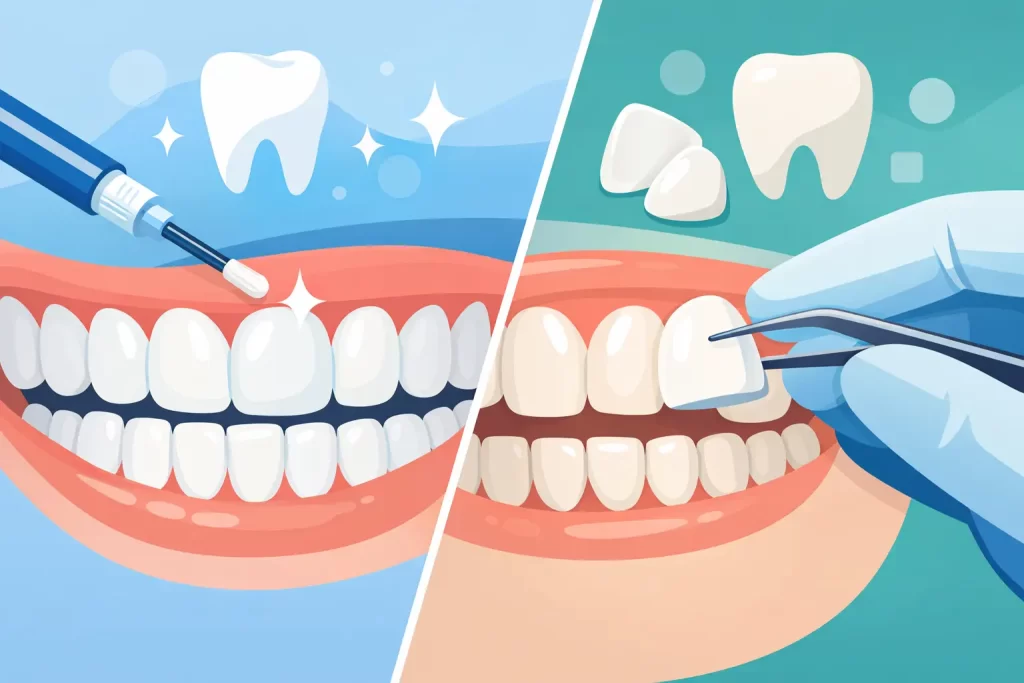
Teeth Whitening vs Veneers: Which Fits?
A brighter smile can change how you feel in photos, at work, and even during everyday conversations. When patients ask about teeth whitening vs veneers, they are usually asking a bigger question: how can I improve my smile in a way that looks natural, lasts well, and makes sense for my teeth?
The honest answer is that both treatments can create beautiful results, but they solve different problems. One is designed to lift stains from natural teeth. The other can reshape and redesign the look of teeth more dramatically. Choosing well starts with understanding what each option can and cannot do.
Teeth whitening vs veneers: the core difference
Teeth whitening is a cosmetic treatment that lightens the shade of your natural enamel. It works best when teeth are healthy overall but look dull, yellow, or stained from coffee, tea, wine, smoking, or normal aging. Whitening keeps your natural tooth structure intact and focuses on improving color.
Veneers are thin coverings placed on the front surface of teeth to improve appearance. They are often used when color is only part of the issue. If teeth are chipped, uneven, worn, slightly misaligned, or have stains that do not respond well to whitening, veneers may offer a more complete cosmetic change.
So while both can make a smile look brighter, whitening treats discoloration. Veneers can change color, shape, size, and overall symmetry.
When teeth whitening makes the most sense
If you like the shape and position of your teeth and mainly want them to look brighter, whitening is often the more conservative starting point. Many patients prefer it because it is simpler, faster, and generally more affordable than veneers.
Professional whitening can be a very good choice for surface staining and general yellowing. It is especially appealing if you want visible improvement without changing the structure of your teeth. For many adults, that is exactly the right level of treatment.
Whitening also works well for patients who want to refresh their smile before an event or simply feel more confident in daily life. It can be part of routine cosmetic care, much like a scale and polishing supports oral health and appearance.
That said, whitening has limits. It will not change the shape of a tooth. It will not close gaps. It will not repair chips. It also may not work evenly on every type of discoloration, especially deep internal stains.
When veneers may be the better choice
Veneers are often chosen when someone wants a more polished, uniform smile or has multiple cosmetic concerns at once. If a tooth is dark, misshapen, worn down, slightly crooked, or uneven next to the others, veneers can provide a more controlled transformation.
This option can be especially helpful when whitening alone would still leave you unhappy with the overall look of your teeth. For example, a person may whiten their teeth successfully but still notice a chipped front tooth, a small gap, or edges that look irregular. Veneers address those details directly.
They can also be useful for teeth with stains that are resistant to whitening. In those cases, trying to whiten repeatedly can be frustrating. Veneers may offer a more predictable cosmetic result.
Still, veneers are not the right fit for everyone. They involve more planning, more investment, and in many cases some degree of tooth preparation. That is why a careful dental assessment matters before making a decision.
Appearance: subtle brightening or full smile redesign?
One of the biggest differences in teeth whitening vs veneers is how much change you want.
Whitening tends to enhance what is already there. Your smile still looks like your smile, just brighter and fresher. For patients who want natural improvement without a dramatic shift, this can feel like the ideal balance.
Veneers allow for more control. Shade, shape, width, length, and symmetry can all be adjusted. If you have always felt that your teeth look too small, uneven, or worn, veneers can create a more noticeable makeover.
Neither approach is automatically better. It depends on whether your goal is refinement or redesign.
Cost and long-term value
For many patients, budget plays a major role in the decision. Whitening is usually the lower-cost option upfront. It can provide an excellent cosmetic boost without the larger commitment that veneers require.
Veneers cost more because they are more customized and involve more clinical work. However, they may offer better value if whitening would not solve the issues bothering you in the first place. Spending less on a treatment that does not truly meet your goals can leave you feeling disappointed.
The best way to think about cost is not only in terms of price, but in terms of suitability. The right treatment should match both your smile goals and the condition of your teeth.
Durability and maintenance
Whitening results are not permanent. Teeth can pick up new stains over time, especially if you regularly drink coffee, tea, red wine, or use tobacco. Some patients choose touch-up treatments from time to time to maintain the brightness they like.
Veneers generally last longer than whitening results, but they still require care. Good brushing, flossing, routine dental visits, and avoiding habits like biting hard objects all matter. Veneers are durable, but they are not indestructible.
It is also worth remembering that whitening works on natural teeth, while veneers are custom-made restorations. That means maintenance is different. If your smile plan may involve crowns, bonding, or other dental work, your dentist will want to consider how all of those pieces fit together for a natural final result.
Tooth health matters more than cosmetics
Before deciding on any cosmetic treatment, the health of your teeth and gums comes first. If you have active decay, gum disease, sensitivity, cracks, or worn enamel, those issues should be addressed before whitening or veneers are considered.
This is where a comprehensive exam becomes so important. A smile may look like it only needs cosmetic improvement, but the safest and most successful results begin with healthy foundations. Preserving natural teeth whenever possible is always the better path.
At Restorative Dental Jamaica, that patient-first approach matters because cosmetic treatment should never come at the expense of long-term oral health. A beautiful smile should also be a healthy one.
Can you whiten first and get veneers later?
Yes, in some cases that is a very sensible plan. If only one or two teeth need veneers and the rest of your smile is healthy, whitening the natural teeth first can help create a brighter overall shade. The veneers can then be matched to that improved color.
This kind of staged treatment is often useful for patients who want a balanced result without doing more than necessary. It also reflects good conservative dentistry: keep what is healthy, improve what needs attention, and avoid overtreatment.
Who is a good candidate for each?
A good whitening candidate usually has healthy teeth, manageable sensitivity, and staining that is likely to respond well. If your teeth are structurally sound and you mainly want them brighter, whitening may be enough.
A good veneer candidate often wants to correct several cosmetic issues at once and has teeth that are otherwise healthy enough to support treatment. Veneers can be a strong option when discoloration is stubborn or when shape and alignment are part of the concern.
If you grind your teeth, have untreated gum problems, or tend to clench heavily, that does not always rule out veneers, but it does mean your dentist needs to plan carefully. The same goes for whitening if you already struggle with sensitivity.
How to choose with confidence
If you are stuck between teeth whitening vs veneers, think about what bothers you most when you look in the mirror. If the answer is simply color, whitening may be the right first step. If the answer includes shape, chips, uneven edges, spacing, or a tooth that never seems to match the others, veneers may be worth discussing.
It also helps to ask yourself how much change you want. Some people want a refreshed version of their natural smile. Others want a more noticeable transformation. Both goals are valid.
The most reassuring path is to have your teeth evaluated in person, with clear guidance based on your enamel, existing dental work, bite, and cosmetic priorities. Digital imaging and close clinical assessment can make these decisions much easier because they show what is really happening beyond a quick glance.
A good cosmetic decision should feel comfortable, informed, and realistic. The best smile treatment is not the one that sounds the most dramatic. It is the one that fits your teeth, your goals, and your long-term dental health. If you are considering a brighter smile, start with a professional conversation and let the right option become clear from there.
Leave a reply







Leave a reply