
Best Treatments for Missing Teeth
A missing tooth changes more than your smile. You may notice it when you chew on one side, when words sound slightly different, or when you catch yourself smiling less in photos. If you are weighing the best treatments for missing teeth, the right choice depends on where the tooth is missing, how many teeth are involved, your oral health, and what feels realistic for your lifestyle and budget.
Replacing missing teeth is not only about appearance, though that matters too. Gaps can affect how you bite, how evenly your teeth wear down, and how supported your facial structure feels over time. In many cases, the sooner you explore treatment, the more options you may have.
Why missing teeth should not be ignored
When a tooth is lost, the surrounding teeth do not simply stay frozen in place. Nearby teeth can begin to shift into the space. The opposing tooth may start to move as well because it no longer has contact during biting. That can lead to changes in your bite, added strain on certain teeth, and sometimes jaw discomfort.
There is also the question of bone loss. Natural tooth roots help stimulate the jawbone. Once a tooth is gone, that stimulation decreases in the area, and the bone can gradually shrink. This is one reason early treatment matters, especially if you are considering an option like a dental implant.
For some patients, the bigger issue is day-to-day confidence. A visible gap can make work conversations, social events, and family photos feel uncomfortable. Good dentistry should support both health and self-assurance.
Best treatments for missing teeth: what are your options?
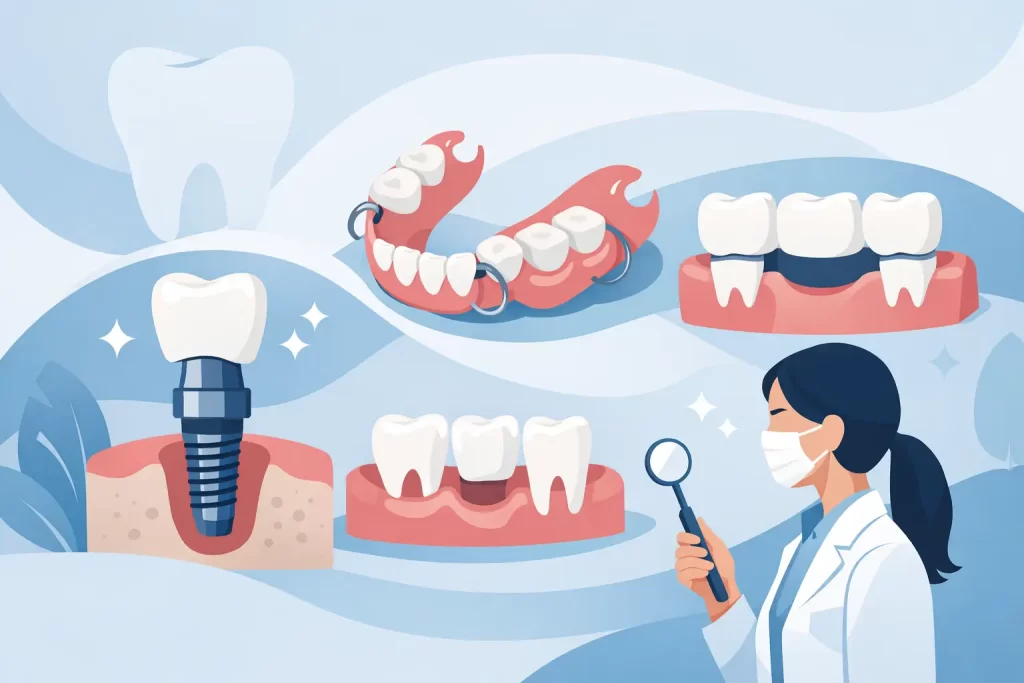
There is no one-size-fits-all answer. The best treatments for missing teeth usually fall into three main categories: dental implants, dental bridges, and dentures. Each has clear advantages, and each comes with trade-offs worth understanding before you decide.
Dental implants
A dental implant is often considered the closest replacement to a natural tooth. It involves placing a small post in the jawbone to act like an artificial root, then attaching a custom crown on top once healing is complete.
For patients missing one tooth, implants are often an excellent choice because they replace the tooth without relying on neighboring teeth for support. They tend to feel secure, look natural, and help preserve bone in the area. Many people also appreciate that an implant can be brushed and cared for much like a natural tooth.
That said, implants are not automatic for everyone. You need enough healthy bone to support the implant, and your gums should be in good condition. Some patients may need preparatory treatment first, such as addressing gum disease or rebuilding bone. Implants also take more time than some alternatives because healing is part of the process. Cost can be a factor as well, although many patients see implants as a long-term investment in comfort and stability.
Dental bridges
A dental bridge fills a gap by anchoring an artificial tooth to the natural teeth on either side. In many cases, those supporting teeth are prepared for crowns, and the bridge is fixed in place.
Bridges can be a very practical option when you want a stable replacement without surgery. Treatment is usually quicker than implants, and the result can restore both chewing function and appearance effectively. For patients who have neighboring teeth that already need crowns, a bridge may make particular sense.
The trade-off is that a bridge relies on surrounding teeth for support. That means healthy teeth may need to be altered in order to place the restoration. Bridges also do not replace the tooth root, so they do not provide the same bone stimulation as an implant. Still, in the right case, a bridge can be a dependable and attractive solution.
Dentures
Dentures remain one of the most common treatments for missing teeth, especially when several or all teeth need to be replaced. They may be partial, replacing some missing teeth, or full, replacing all teeth in an arch.
Modern dentures can look far more natural than many people expect. They can improve speech, restore facial support, and help patients return to more comfortable daily function. Partial dentures are often useful when several teeth are missing in different parts of the mouth and a fixed option is not ideal.
Dentures do require an adjustment period. They may feel bulkier than fixed solutions, and some patients find that stability while eating is not the same as with implants or bridges. Over time, as the shape of the gums and jaw changes, dentures may need relining or replacement. Even so, for many patients, dentures offer an effective and accessible way to restore the smile.
How to choose the right treatment
The best choice depends on your clinical needs and your priorities. If your goal is the most natural feel and long-term bone support, an implant is often worth discussing first. If you want a fixed option without surgery, a bridge may fit better. If you are missing many teeth or need a more budget-conscious approach, dentures may be the most sensible path.
Age alone is not the deciding factor. What matters more is your overall oral health, the condition of your gums, the strength of nearby teeth, and whether you are ready for the time and cost involved in treatment. A careful dental assessment with digital imaging can help clarify what is possible and what makes the most sense.
It is also worth thinking honestly about your routine. Some patients want the lowest-maintenance option. Others are comfortable with removable appliances if it means treatment is simpler or more affordable. A good dental plan should match real life, not just an ideal scenario on paper.
When replacing one tooth is different from replacing several
A single missing front tooth and multiple missing back teeth are very different situations. If one front tooth is missing, appearance may be the top concern, and the solution needs to blend naturally with the rest of the smile. In that case, an implant or a carefully designed bridge may be ideal.
If several back teeth are missing, chewing ability and bite support become bigger issues. A partial denture may restore function efficiently, or implants may be used to support more fixed treatment depending on the case. When all teeth are missing, full dentures are often the starting point, though some patients may benefit from implant-supported options for added stability.
This is why treatment should always be personalized. The best option for one patient may be the wrong option for another, even if both are missing teeth.
What to expect during your consultation
A consultation for missing teeth should feel informative, not rushed. Your dentist should assess the health of your gums and remaining teeth, review digital x-rays, and look at your bite, bone levels, and overall goals for treatment. You should also have space to talk about comfort, timing, and budget.
This conversation matters because replacing missing teeth is not only a technical procedure. It affects how you eat, speak, clean your teeth, and feel about your smile every day. At a patient-centered practice like Restorative Dental Jamaica, that discussion should leave you feeling clear about your options and confident about the next step.
Caring for your replacement teeth
No matter which treatment you choose, maintenance is part of long-term success. Implants, bridges, and dentures all need regular dental checkups and proper home care. Plaque can still build up around restorations, gums still need monitoring, and changes in your bite or fit should be addressed early.
Patients sometimes assume that once a missing tooth is replaced, the problem is finished for good. In reality, the restoration is only as successful as the care that follows. The good news is that with regular visits and good habits, replacement teeth can serve you very well for years.
If you are living with a gap, struggling to chew comfortably, or putting off treatment because you are unsure what to choose, start with a conversation. The best time to replace a missing tooth is usually earlier than later, and the best solution is the one that restores your comfort, protects your oral health, and helps you smile without hesitation.
Leave a reply







Leave a reply