
Dental Crown Versus Filling: Which Fits?
A small cavity can often be fixed quickly. A cracked or heavily weakened tooth is a different story. When patients ask about dental crown versus filling, they are usually trying to answer one practical question: can this tooth be repaired simply, or does it need stronger long-term protection?
That decision matters for your comfort, your budget, and the future of the tooth. The right treatment is not about choosing the more advanced option just because it sounds better. It is about preserving as much healthy tooth structure as possible while making sure the tooth can still function safely when you bite, chew, and smile.
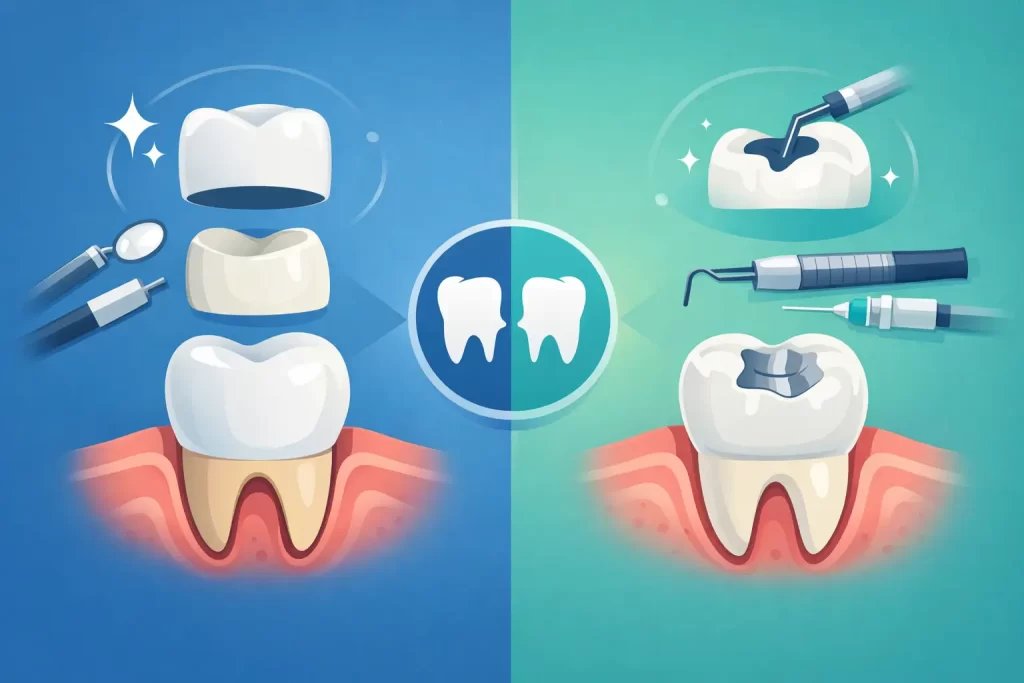
Dental crown versus filling: the basic difference
A filling repairs a smaller area of damage inside the tooth. After decay is removed, the space is filled with a restorative material, often tooth-colored composite, to rebuild the shape and seal the area.
A crown covers most or all of the visible part of the tooth above the gumline. It is custom-made to fit over a prepared tooth and is used when the tooth needs more support than a filling can realistically provide.
The easiest way to think about it is this: a filling patches damage, while a crown protects and reinforces a tooth that has lost too much strength. Both are common, effective treatments. The better choice depends on how much natural tooth remains and how much pressure that tooth handles every day.
When a filling is usually enough
If decay is caught early to moderate and the tooth still has strong surrounding structure, a filling is often the more conservative option. This is especially true for small cavities or when an old filling needs to be replaced before the tooth becomes too compromised.
A filling can also be a good choice for minor chips or worn areas, particularly in places where the tooth is not under extreme biting force. Because less tooth structure is removed during treatment, fillings help preserve more of your natural tooth.
For many patients, that is a real advantage. Treatment is generally faster, less invasive, and more affordable upfront. Tooth-colored fillings also blend in well, which makes them appealing for visible areas of the mouth.
That said, a filling has limits. If the damaged section is too large, the remaining tooth can become prone to fracture. A very big filling may restore the shape of the tooth, but not necessarily the strength you need.
Signs a filling may be appropriate
A filling is commonly recommended when the cavity is relatively small, the tooth walls are still intact, and there is no major crack or structural weakness. It also tends to work well when the tooth has not had extensive prior dental work.
Your dentist will usually look at the size of the decay, the tooth’s location, and whether the remaining enamel and dentin can support a restoration safely over time.
When a crown is the better option
A crown is often the better choice when the tooth has lost too much structure to rely on a filling alone. This may happen after a large cavity, a fracture, repeated replacements of older fillings, or a root canal.
Back teeth are a common example. Molars absorb significant chewing pressure every day. If one of them has a wide area of damage, placing another large filling may leave the tooth vulnerable to breaking. In that case, a crown can act like a protective outer shell.
Crowns are also frequently used for teeth that are cracked but still restorable. The goal is to hold the tooth together and reduce the chance of the crack spreading. In cosmetic cases, crowns may also improve shape, color, or overall appearance, but protection is still the main reason in most restorative situations.
Signs a crown may be needed
A crown may be recommended if a tooth has a large existing filling with very little healthy tooth left, if a cusp has broken, if the tooth has had root canal treatment, or if biting causes concern about fracture risk. A tooth can sometimes look fine from the outside and still be structurally weak, which is why an exam and x-rays are so important.
Cost matters, but value matters more
Many patients understandably compare the cost first. Fillings usually cost less than crowns because they require less material, less time, and a simpler procedure. If the tooth can be restored well with a filling, that often makes sense.
But lower cost today is not always lower cost long term. If a filling is used on a tooth that really needs a crown, that tooth may crack later and require a larger repair, root canal treatment, or even extraction. On the other hand, placing a crown too early when a filling would do the job can mean more treatment than necessary.
This is why good restorative care should never feel rushed. A careful evaluation helps you understand not just the fee, but the likely lifespan of the treatment and the risk of future problems.
Appearance and comfort
Patients often assume a filling will always look more natural, but modern crowns can be highly esthetic as well. Both options can be made to blend beautifully with your smile when planned well.
Comfort depends less on whether you get a crown or filling and more on the condition of the tooth before treatment. A tooth with deep decay, sensitivity, or a crack may already be irritated. Once the damage is removed and the tooth is properly restored, many patients feel significant relief.
A filling is usually completed in one visit. A traditional crown often involves at least two stages, with a temporary crown while the final one is made. Some patients prefer the speed of a filling, while others appreciate the added security a crown provides for a compromised tooth.
Dental crown versus filling after a root canal
This is one of the most common points of confusion. After a root canal, the tooth may no longer have pain, but it is often weaker than before. If the opening created for treatment is small and the tooth still has strong structure, a filling may sometimes be enough, especially for certain front teeth.
For many back teeth, though, a crown is often the safer long-term option after root canal treatment. These teeth handle more chewing force, and the risk of fracture is higher. Covering the tooth with a crown can help protect the investment you already made in saving it.
This is a good example of why there is no one-size-fits-all answer. The type of tooth, the amount of remaining structure, and your bite all matter.
How dentists decide between the two
A responsible recommendation should be based on what your tooth needs, not on a standard script. Your dentist will look at the extent of decay, whether there are cracks, the size of any existing filling, your chewing pattern, and what shows up on digital x-rays or intraoral images.
Sometimes the decision is straightforward. Sometimes it is a judgment call between preserving more tooth now and providing more coverage for the future. In those situations, a clear conversation matters. You should understand why one option is being recommended, what the trade-offs are, and what could happen if treatment is delayed.
At Restorative Dental Jamaica, that kind of discussion is part of patient-centered care. People feel more confident when they know what is happening with their tooth and why a certain treatment offers the best chance of keeping it healthy.
What happens if you wait too long?
The biggest mistake is often not choosing the wrong restoration. It is waiting until a tooth that could have been fixed with a filling becomes a crown case, or until a tooth that needed a crown breaks beyond repair.
Decay does not stay still. Cracks rarely improve on their own. A tooth that only feels mildly sensitive today can become painful, infected, or harder to restore later. Early treatment usually gives you more options and often helps keep care simpler.
If you have been told you need treatment and are unsure whether it should be a crown or filling, that is a good time to ask questions rather than postpone care. The sooner the tooth is evaluated, the more likely it is that it can be preserved comfortably and predictably.
The best choice is the one that protects your tooth
There is no universal winner in the question of dental crown versus filling. A filling is excellent when the damage is limited and the tooth is still strong. A crown is the better option when the tooth needs real structural support.
What matters most is not choosing the smaller treatment or the bigger treatment. It is choosing the one that gives your tooth the best chance to stay healthy, functional, and comfortable for years to come.
If something feels off with a tooth, trust that instinct and have it checked. A simple appointment today can make the difference between a straightforward repair and a much more complicated problem later.
Leave a reply








Leave a reply