
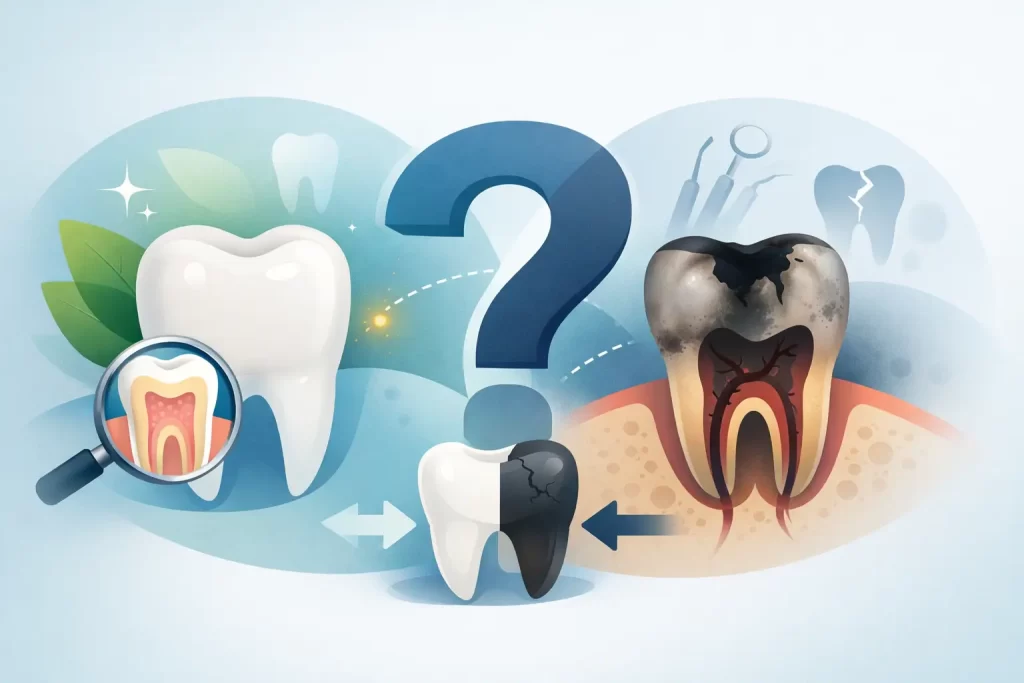
Can a Dead Tooth Be Saved?
A tooth that turns dark, stops responding, or starts throbbing can make people assume the worst. The good news is that can a dead tooth be saved is often a very reasonable question to ask, because in many cases, yes, it can be treated and kept in place. The key is knowing what “dead” really means and getting it assessed before the damage spreads.
When patients hear the phrase dead tooth, they often picture a tooth that is beyond repair. In reality, the term usually means the pulp inside the tooth has lost its blood supply and nerve function. The outer tooth structure may still be strong enough to save, especially if treatment starts early.
What a dead tooth actually means
Inside every tooth is a soft center called the pulp. It contains nerves, blood vessels, and connective tissue. If that pulp becomes badly inflamed, infected, or cut off from circulation after trauma, it can die.
This can happen after deep decay, a crack, repeated dental work on the same tooth, or a hit to the mouth during sports or an accident. Sometimes the change is sudden and painful. Other times, the tooth quietly loses vitality over time and the first sign is discoloration.
A dead tooth does not always mean a tooth has to come out. What matters most is whether the remaining tooth structure, surrounding bone, and gum support are still healthy enough for restoration.
Can a dead tooth be saved with treatment?
In many situations, can a dead tooth be saved with treatment has a straightforward answer: yes, often through root canal therapy followed by protection of the tooth with a filling or crown. Root canal treatment removes the damaged or infected pulp, disinfects the inside of the tooth, and seals it so bacteria cannot easily return.
Once that source of infection is removed, the tooth can often continue to function for many years. Because the nerve is gone, the tooth will no longer have the same internal nourishment it once had, so it may become more brittle over time. That is why many dead teeth, especially back teeth, do best with a crown after treatment.
Still, there are limits. If the tooth is severely cracked below the gumline, has too little healthy structure left, or the infection has caused major bone loss, saving it may not be the best option. In those cases, removing the tooth and planning a replacement can protect your overall oral health.
Signs that a tooth may be dying
Not every dead tooth hurts. That is one reason people sometimes wait longer than they should. A dentist will usually look at symptoms, exam findings, and imaging before confirming whether the pulp is no longer alive.
Common signs include persistent pain, pain when biting, swelling around the gum, a pimple-like bump near the tooth, gray or dark yellow discoloration, increased sensitivity that later disappears, or a tooth that feels different from the teeth around it. Sometimes there is a bad taste or odor if infection is draining.
Pain can also come and go, which can be misleading. If the tooth stops hurting, that does not always mean it healed. Sometimes it means the nerve has stopped functioning while infection continues around the root.
How dentists decide if the tooth can be preserved
Saving a dead tooth depends on more than one factor. A proper dental assessment is what separates a savable tooth from one that is no longer predictable to keep.
Your dentist will usually examine the tooth visually, check the gums, test how the tooth responds to pressure, and use digital x-rays to look for infection around the root. In some cases, an intraoral camera can also help patients clearly see cracks, decay, or structural damage.
The main questions are simple. Is the infection manageable? Is there enough healthy tooth left to restore? Is there a crack running into the root? How much support remains from the surrounding bone and gum tissue? A tooth may be non-vital and still be very restorable, or it may look fine on the surface but have a deep fracture that changes the plan completely.
Root canal therapy is often the turning point
For many patients, root canal therapy is what makes tooth preservation possible. Despite its reputation, modern root canal treatment is typically far more comfortable than people expect. Most patients are relieved to be out of pain and happy to keep their natural tooth.
The treatment removes infected tissue from inside the tooth, cleans and shapes the canals, and seals them. After that, the tooth is rebuilt. Front teeth may sometimes be restored with a filling if enough structure remains. Back teeth usually need a crown because they absorb stronger chewing forces.
This combination matters. Treating the inside of the tooth without properly restoring the outside can leave it vulnerable to fracture or leakage later on.
When a crown makes all the difference
A dead tooth can survive root canal treatment and still fail if it is left weak. That is where a crown becomes important. A crown covers and protects the remaining tooth structure, helping restore strength, shape, and function.
This is especially useful when the tooth had a large cavity, a previous large filling, or a crack that did not extend too far. If the tooth is visible when you smile, a crown can also improve appearance when discoloration is a concern.
Some dead teeth darken even after successful treatment. If that happens, your dentist may discuss cosmetic options depending on the tooth and the level of staining. Function comes first, but appearance matters too, especially for front teeth.
When a dead tooth cannot be saved
There are times when preserving the tooth is no longer the healthiest choice. If a crack extends deep into the root, if the tooth is too broken down to support a restoration, or if infection has severely compromised the surrounding support, extraction may be recommended.
That can be disappointing, but it is not a failure. Sometimes the best way to protect nearby teeth and stop ongoing infection is to remove a tooth that has poor long-term prospects. What matters is making that decision early and planning the next step well.
Depending on your needs, a missing tooth may later be replaced with a bridge, denture, or another restorative option. The right choice depends on the location of the tooth, your bite, your budget, and your long-term goals.
Why waiting can reduce your options
One of the biggest mistakes patients make is waiting until the tooth becomes unbearable. The longer infection remains, the more likely it is to spread into the surrounding bone or cause swelling, abscess formation, and structural breakdown.
A tooth that might have been saved with root canal treatment and a crown can become non-restorable if too much of it fractures away. Early care often means simpler treatment, less discomfort, and a better chance of keeping your natural tooth.
This is also where regular dental visits matter. Some dying teeth are found on routine exams before severe pain starts. That gives you more options and more control over the outcome.
What to do if you think you have a dead tooth
If you notice discoloration, swelling, lingering pain, or a tooth that suddenly feels “off,” book an exam as soon as possible. Avoid chewing on that side, keep the area clean, and do not assume the problem will settle on its own.
A professional evaluation can tell you whether the tooth is truly non-vital, whether infection is present, and whether treatment can preserve it. At Restorative Dental Jamaica, that conversation is centered on comfort, clarity, and preserving healthy tooth structure whenever possible.
The most reassuring answer to can a dead tooth be saved is this: often, yes, but timing matters. The sooner you have it checked, the better the chance of keeping your natural tooth, staying comfortable, and protecting the rest of your smile.
If a tooth has changed color, started aching, or simply does not feel right, trust that instinct and get it looked at. A calm, early assessment can make the difference between losing a tooth and saving one you thought was already gone.
Leave a reply







Leave a reply