
What Is Restorative Dental Care?
A small chip, a painful toothache, or a missing tooth can change more than your smile. It can affect how you eat, speak, and feel day to day. If you have been wondering what is restorative dental care, the simple answer is this: it is the part of dentistry focused on repairing damaged teeth, replacing missing teeth, and helping your mouth work comfortably again.
Restorative dental care is not only about appearance, although that often improves too. Its main purpose is to restore strength, function, and long-term oral health. For many patients, it is the step that helps them move from discomfort and worry to relief and confidence.
What Is Restorative Dental Care and What Does It Treat?
Restorative dental care covers treatments used to fix teeth that are decayed, broken, worn down, infected, or missing. It also includes solutions that protect the structure of your mouth so small issues do not become larger ones.
If you have a cavity, a cracked tooth, an old failing filling, or a tooth that has been lost, restorative treatment may be recommended. In some cases, the goal is to save your natural tooth. In others, the goal is to replace what has been lost in a way that feels stable and looks natural.
That distinction matters. Good restorative care is not one-size-fits-all. The right treatment depends on how much tooth structure remains, whether there is pain or infection, your overall oral health, and your budget and preferences.
Common restorative treatments
The treatment itself depends on the problem, but several services fall under restorative dental care.
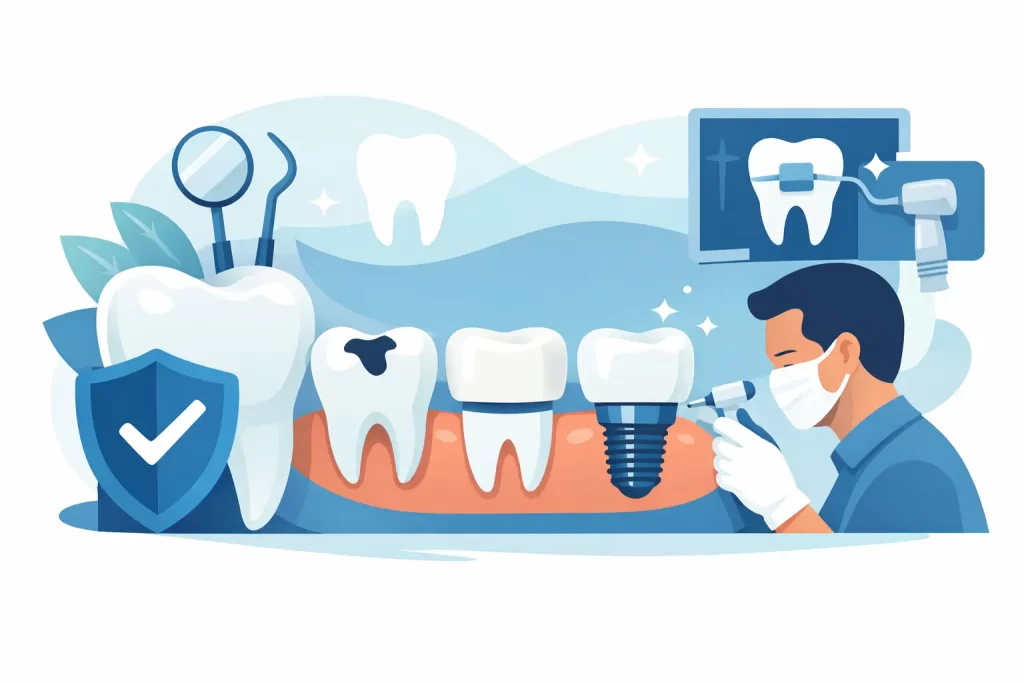
White fillings are one of the most common. They are used to repair teeth affected by decay or minor damage. A filling closes the space left by a cavity and helps the tooth function normally again. When caught early, this is often the simplest and most affordable way to restore a tooth.
Dental crowns are used when a tooth is too weak or damaged for a filling alone. A crown covers the visible part of the tooth and adds protection and strength. Crowns are often recommended after large cavities, fractures, or root canal treatment.
Root canal therapy is designed to save a tooth when the inside tissue has become infected or inflamed. Many patients are nervous about hearing they need a root canal, but the treatment is often what relieves pain and prevents extraction. Saving the natural tooth is usually the preferred outcome when possible.
Dentures help replace several missing teeth or a full arch of teeth. Modern dentures are made to improve chewing, speaking, and smile appearance. Depending on the patient, dentures may be a practical and life-improving solution.
Tooth extractions can also be part of restorative care, even though removing a tooth may not sound restorative at first. If a tooth cannot be saved, extraction may be the healthiest next step, especially when it prevents infection or ongoing pain. After that, a replacement plan can be discussed.
Why restorative care matters early
Many people wait until a dental problem becomes painful before they book an appointment. That is understandable, but it often means the treatment needed is more involved than it would have been earlier.
A small cavity can often be repaired with a filling. Leave it too long, and the same tooth may eventually need a crown or root canal. A cracked tooth may be protectable at first, but if the crack deepens, the tooth may become impossible to save.
Early restorative care can reduce discomfort, preserve more of your natural tooth, and usually lower long-term costs. It also helps avoid the kind of disruption that comes with dental emergencies.
Restorative vs cosmetic dental care
Patients sometimes confuse restorative and cosmetic dentistry because both can improve how a smile looks. The difference is in the main goal.
Restorative dentistry focuses first on health and function. It repairs damage, treats disease, and replaces missing teeth. Cosmetic dentistry focuses mainly on appearance, such as whitening, veneers, or bonding to improve color, shape, or symmetry.
That said, there is often overlap. A white filling restores a decayed tooth, but it also blends in naturally. A crown protects a damaged tooth, but it can also improve its appearance. In real life, many patients want both – a healthy smile and one that looks good when they talk and laugh.
What is restorative dental care like as a patient?
For most patients, restorative care starts with an assessment. Your dentist examines your teeth, may take digital x-rays, and looks at the condition of the gums, bite, and surrounding teeth. This part is important because visible damage is only part of the picture.
From there, your treatment plan is based on what your mouth needs now and what will best protect it moving forward. Sometimes that means doing the most urgent treatment first, such as addressing pain or infection. Other times, it means phasing care over several visits so it feels manageable financially and practically.
A patient-centered dental office should also explain your options clearly. For example, one tooth may be treatable with either a filling or a crown depending on the extent of damage. One option may cost less now, while the other may offer more strength over time. Good care means helping you understand those trade-offs, not rushing you into a decision.
Signs you may need restorative treatment
Not every dental issue causes immediate pain, so it helps to know what to watch for. You may need restorative care if you have tooth sensitivity, pain when chewing, visible holes or dark spots, a broken tooth, a loose filling, swollen gums around one tooth, or a missing tooth.
You may also need treatment if your teeth feel worn down, if food keeps trapping in one area, or if an old crown or denture no longer fits well. Even if the problem seems minor, it is worth getting checked. Small warning signs have a way of becoming larger ones when ignored.
The value of preserving natural teeth
One of the biggest goals in restorative dentistry is preserving your natural teeth whenever possible. Your natural tooth structure is strong, efficient, and worth protecting.
That is why treatments like fillings, crowns, and root canals matter so much. They are often designed to keep a tooth in place and functioning for years rather than removing it too quickly. Extraction is sometimes necessary, but it is generally not the first choice when a tooth can still be saved predictably.
This is also where modern technology helps. Digital imaging and intraoral cameras can support earlier diagnosis and more precise treatment planning. For patients, that often means better understanding and more confidence in the care they are receiving.
Choosing the right dental provider for restorative care
Restorative treatment is not just about the procedure. It is also about how you are cared for throughout the process. If you have dental anxiety, a busy work schedule, or concerns about cost, those things matter.
A good dental provider should make the experience feel clear and comfortable. That includes taking time to explain treatment, answering questions honestly, and offering a calm environment that helps you feel at ease. Flexible payment options can matter too, especially when care involves multiple visits.
For families and working professionals, convenience also counts. Being able to access comprehensive care in one trusted office can make it easier to stay consistent with treatment and follow-up visits.
What is restorative dental care really about?
At its heart, restorative dental care is about getting you back to normal – or better than normal if your teeth have been causing discomfort, limiting what you eat, or making you hide your smile. It is practical care with a real impact on daily life.
Whether the solution is a simple filling or a more involved treatment plan, the right care should leave you feeling informed, supported, and confident about what comes next. At Restorative Dental Jamaica, that means combining modern treatment with a warm, comfortable experience that helps patients feel looked after from the moment they arrive.
If you think something in your mouth does not feel right, do not wait for it to get worse. A timely dental visit can protect your natural teeth, ease discomfort, and make the path forward much simpler.
Leave a reply







Leave a reply